

“When I’m 64”
A birthday reflection on a song by The Beatles I can't stand.

Tomorrow is when I’m 64.
I find myself confronting the age that The Beatles’s song, “When I’m 64,” marked for a whole generation of Boomers as the beginning of the long slow decline toward infirmity — a year of “losing my hair,” a need to “scrimp and save,” and to be “sincerely, wasting away.”
Woohoo! Can’t wait!
The song always annoyed me as a trite interruption in the Beatles’s song book, and now that I’m 64 it actually ticks me off that the reflections of a younger man on the bleak valley of aging is accompanied by an almost vaudevillian set of high notes from a trio of clarinets.
Clarinets! Really?
It didn’t take much research to learn what I had presumed all along: it was written by Paul McCartney. Of course, right? After all, he did create the band Wings which in 1976 put a stake through the heart of the 1960s musical revolution with a single top-of-the-charts hit: “Silly Love Songs.” But what I did not realize was that “When I’m 64” was the first song McCartney ever wrote. And I did not know that he composed it in 1954 when he would have been just 14 years old. So he can be forgiven for writing a song like this as an adolescent especially since he would go on to write masterpieces like “Yesterday” and “Hey Jude.” Still, we all know that John Lennon would have never, ever composed something so damn saccharine as “When I’m 64.” After all, Lennon always seemed more focused on the rage of Aquarius than the age of Aquarius, and it is a safe bet to presume that he would not have stopped as a teenager to ponder the grim bargain of aging and the angst that comes with it.
It’s hard to imagine, but I learned that The Beatles would play this song in the cellar clubs of Hamburg, Germany in their earliest days as a band before they landed in New York in February 1964 for their first American tour and the country was swept up in Beatlemania. The song would not see the light of day on an album until 1967 when the iconic “Sgt. Pepper’s Lonely Hearts Club Band” was released, the year McCartney’s own father, a musician who played the trumpet, actually turned 64. Unsurprisingly, Lennon is said to have detested the song from the minute he heard it, and contributed only the first two lines of this verse about the garden and digging weeds:
“Doing the garden, digging the weeds
Who could ask for more?
Will you still need me, will you still feed me
When I’m 64?”
Cue the clarinets. Ugh!
On June 18, Sir Paul McCartney turned 84 years old, a full 20 years beyond his predictions of infirmity. And, well, the old man actually looks pretty damn good. Sir Paul was seen on his birthday out and about humorously mocking Donald Trump’s dance moves and having a laugh with Jimmy Fallon. And, it looks like he didn’t really lose his hair after all.
So maybe 64 is not all that bad, and definitely not the end of the road. I haven’t lost my hair, at least not all of it. And I’m not “wasting away,” not yet anyway. Every year we are all living a lot longer than our parents’ generation. Globally, average life expectancy has gone from about 50 years in 1962 to 71 years today. And in America, average life expectancy has gone from 69 years in 1962 to 79 years today.
We are going to be around watching the world turn for a lot longer than it seemed back in the early 1960s, and John Lennon was trying to help us frame an existential question amid the often senseless violence unfolding in 1968 through his anthem “Revolution:”
“Don’t you know it’s gonna be alright? Alright. Alright.”
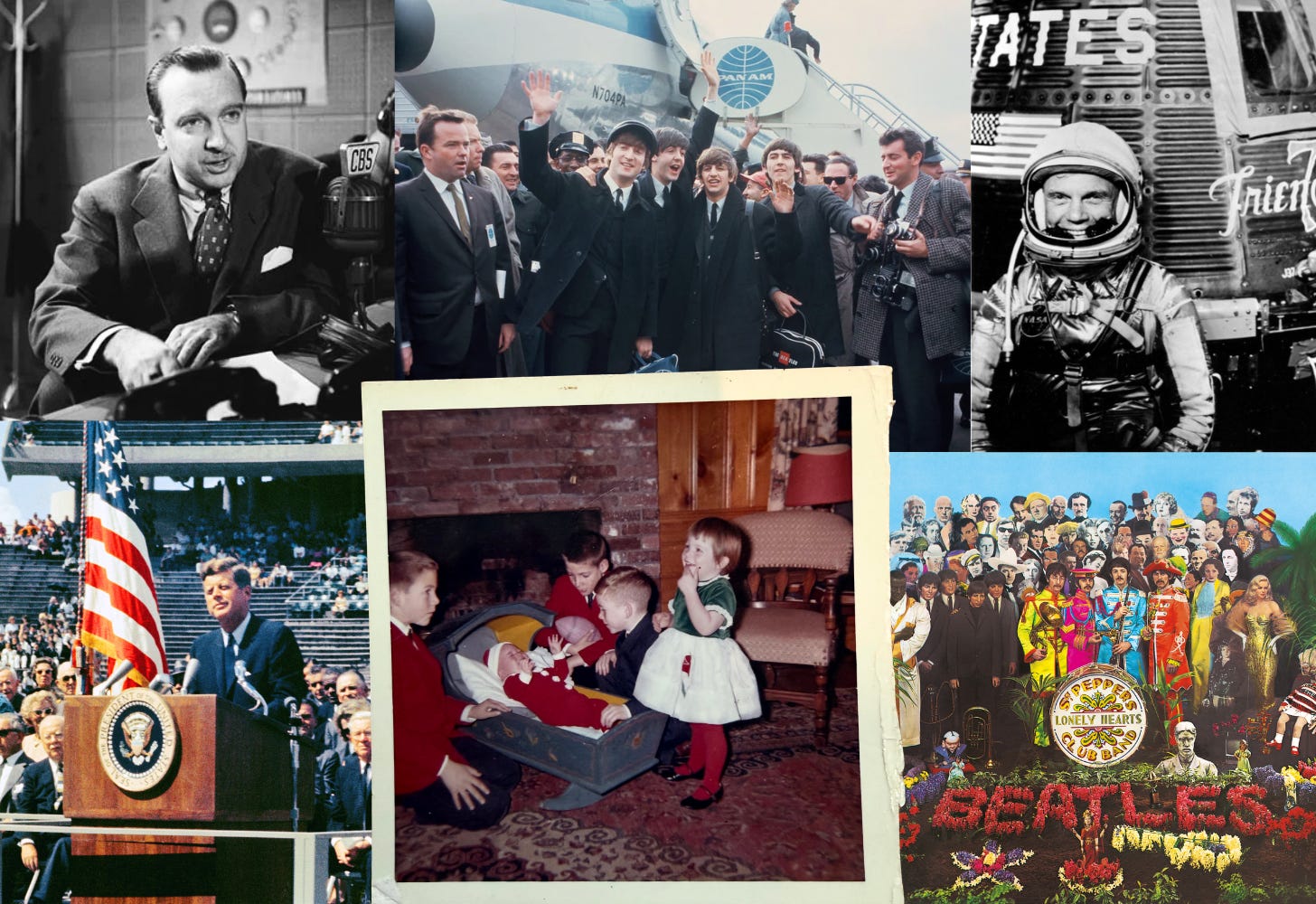
The year I was born in 1962 feels like one of those years on the precipice of history. It is the last full year within the age bracket known as Baby Boomers, a generation born after World War II at the height of the American Century. It was the first year the Beatles landed a recording label. It was the year that John Glenn became the first American to go to space and orbit the earth and the year that President John F. Kennedy would deliver his famous “We Choose To Go To the Moon” speech and set the goal of a lunar landing.
Sifting through some research on my birth year, I also learned that 1962 was the year that Walter Cronkite became the anchor of CBS News and would go on to become the most trusted man in America before he stepped out of the anchor chair in 1981. It pushed me to reflect on the revolution in media I have witnessed in my 64 years on earth. I remember my father enforcing silence in our unruly home when Cronkite came on. The CBS Nightly News was a reverent moment to try to understand a world that felt like it was falling apart with the assassinations of JFK, RFK and MLK and datelines from Vietnam and the deep South during civil rights marches and then the Watergate hearings and the toppling of a president.
Cronkite’s departure in 1981 coincided with the advent of a new cable television channel known as CNN and the era of 24-hour news, unleashing a new revolution in media and a very different pace to consuming information that bombarded us with live images and “breaking news” but didn’t seem as effective in helping us understand what it all meant. And by 1990, we were turning a corner on yet another new era in media as the first browser was launched on the newly created World Wide Web, opening up a pathway to a universal, linked information system. And we all are quite aware where the internet and its algorithms have taken us. Despite the ubiquity of LinkedIn, we are more fractured than ever. Despite the promises of social media, we are more lonely as a country and a world than we’ve ever been. Now a quarter century after the advent of the internet, we are on the cusp of the next revolution in technology and the next transformation of how we will share information across the world. With artificial intelligence we are entering a new and uncertain void as vast and dark as the space that John Glenn plunged through on his orbit around the earth in that year I was born 64 years ago.
So where are we today? Cronkite would not even recognize the CBS News division that he inherited from Edward R. Murrow, and he would certainly be horrified by the network’s dramatic state of collapse. Space exploration no longer has the romance of Kennedy’s “New Frontier” and is instead seen as the next revenue stream for a brilliant, but deranged inventor who this year became the world’s first trillionaire with Space X shares peaking on June 16. And as for superintelligent AI, we truly don’t know what it has in store for humanity, say, 64 years from now. The only thing we know for sure is that it represents a true revolution, and we are left with John Lennon’s question in the Beatles’ song Revolution still echoing across the generations:
“Don’t you know it’s gonna be alright?”
Happy Birthday, Charlie!
That's kinda blistering Charlie---how much is organic disdain and how much is because you're pissed at being 3-score-4?! Happy birthday ol' pal.